Auditory Where-Stream (Dorsal)
- Evidence for a postero-dorsal stream in auditory spatial processing is just as strong, if not stronger, in the human as in nonhuman primates (Rauschecker & Scott (2009) - Nature Neuroscience)
- In the last several years, however, there has been mounting evidence suggesting that the concept “where” may be an insufficient characterization of the dorsal stream (Hickok & Poeppel (2004) - Cognition)
- left-hemisphere dominant (Hickok & Poeppel 2007 - Nature) → siehe Lateralization in Auditory Stream
Location
- starts in PPo → pSTG (Ahveninen et al. (2006) - PNAS)
- seems strongly left lateralized (Hickok and Poeppel, 2007) (Frühholz (2015) - NeuroImage)
- originate in multiple STG seed regions and prob. terminate in anterior/posterior IFG (Fruhholz and Grandjean, 2013b) (Frühholz (2015) - NeuroImage)
-
- The dorsal stream projects dorso-posteriorly, involving a region in the posterior Sylvian fissure (Spt) at the parietal – temporal boundary (area Spt), and ultimately projecting to frontal regions. (Hickok & Poeppel (2004) - Cognition)
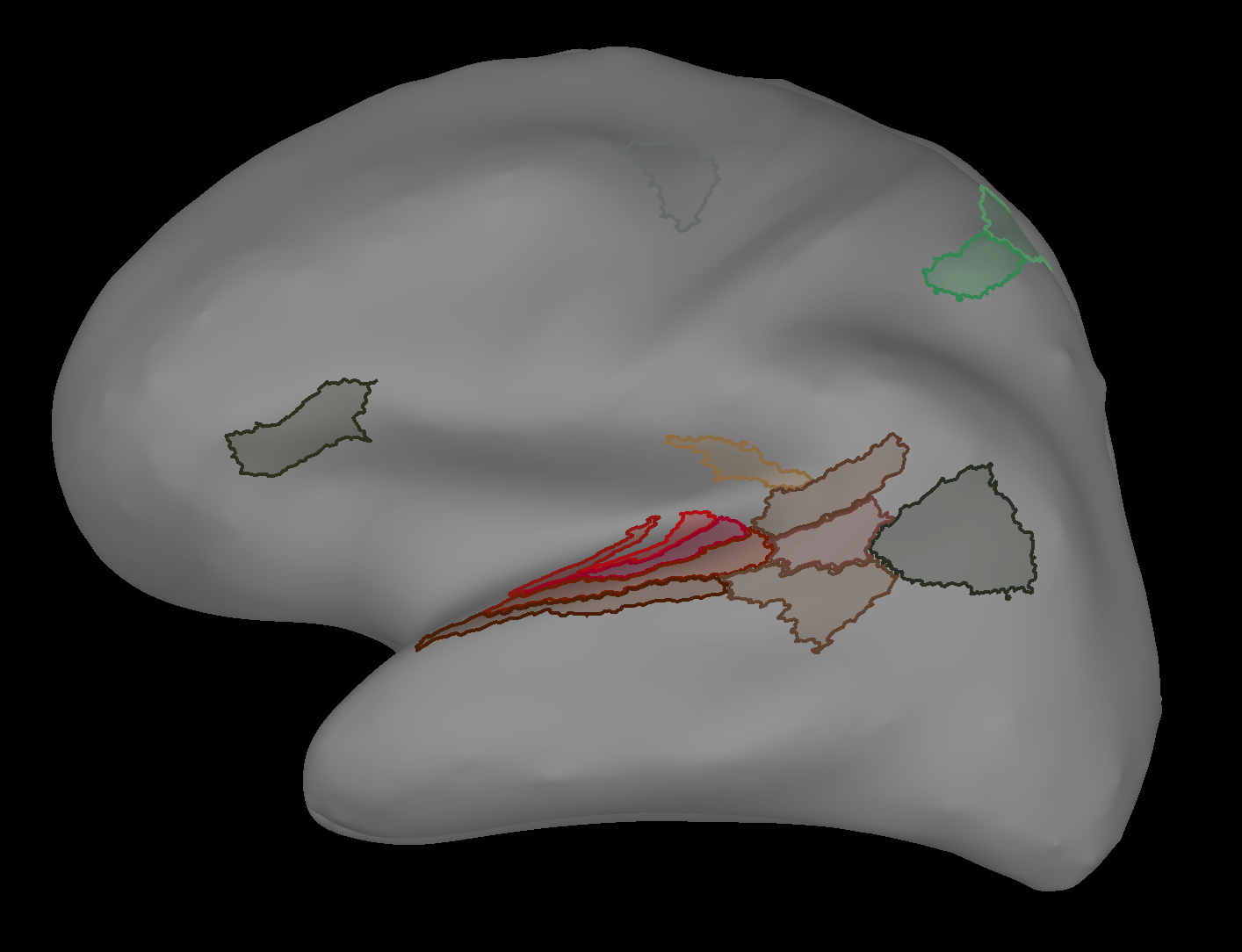
Areas
- inferior parietal and premotor cortices are all part of this dorsal stream network (Rolls et al. (2023) - Cerebral Cortex)
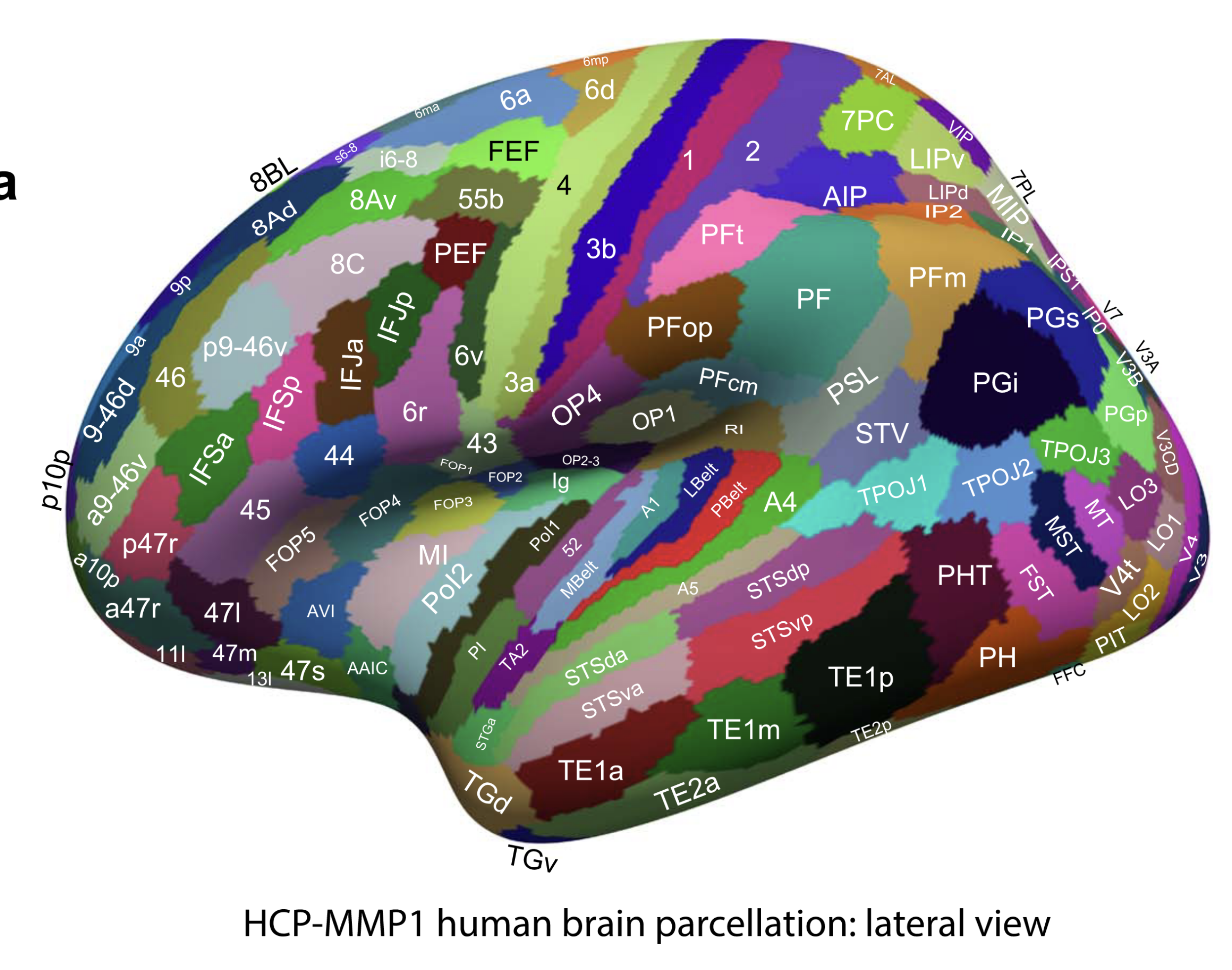
mögliche areas:
PBelt*
MBelt/LBelt*
A4
A5
MT
MST
BA44, 44
FEF
TPOJ1
STV
PSL
PGi
7AL
7PC
PFcm
Function
- function of the dorsal stream is debated (Hickok & Poeppel (2004) - Cognition)
- critical for audio-motor integration, similar to visual domain (Hickok & Poeppel (2004) - Cognition)
- involved in mapping sound onto articulatory-based representations. (Hickok & Poeppel (2004) - Cognition)
- authors suggest that temporal-parietal systems can map auditory speech representations onto motor representations (Hickok & Poeppel (2004) - Cognition)
terminology:
- The suggestion that the dorsal stream has an auditory–motor integration function differs from earlier arguments for a dorsal auditory ‘where’ system (Hickok & Poeppel 2007 - Nature)
Spatial Processing
- posterior to Herschl’s Gyrus are involved in spatial processing (Ahveninen et al. (2006) - PNAS)
- Spatial information as a grouping cue for segregating into discrete sounds. (Cohen et al. (2016) - Springer)
- the dorsal pathway also contributes to auditory perception; consistent with that notion, activity in the human parietal lobe is modulated by listeners’ choices (Cusack 2005). (Cohen et al. (2016) - Springer)
Sensorimotor integration
- sound-to-motor-mapping (Saur et al, 2008) (Frühholz (2015) - NeuroImage)
- involved in sensorimotor integration and control (Rauschecker 2011) (Rolls et al. (2023) - Cerebral Cortex)
- evolved presumably from connecting motor and sensory systems and basal ganglia (Rolls et al. (2023) - Cerebral Cortex)
language processing
- processing of temporal auditory sequences (Belin and Zatorre, 2000b; Rauschecker & Scott (2009) - Nature Neuroscience) (Frühholz (2015) - NeuroImage)
- overall bilateral predominance of the dorsal pathway for processing affective prosody (Frühholz (2015) - NeuroImage)
Connectivity
- involves only a portion of the PT (Hickok & Poeppel 2007 - Nature)
- part of the Auditory Where-Stream (Dorsal)
see also
Tags: neuroscience science dorsal where spatialprocessing prosody
Superlink: 050 🧠Neuroscience
Auditory Streams Overview
Auditory What-Stream (Ventral)
Attention in the auditory stream
DAN
Where-pathway
Source
Created: 2025-11-11 15:23