Auditory Streams Overview
Comprehensive Working Summary of the Auditory What- and Where-Streams
Diese Seite ist eine zusammengefasste, strukturierte Übersicht über alles, was wir bisher über die auditorischen What- und Where-Streams gesammelt haben. Sie kombiniert die funktionale Theorie, die klassische Aufteilung der Streams und die Bedeutung der Prefrontal Target Regions (FEF & IFJ).
Background: What vs. Where
The auditory system is commonly described as consisting of two major processing streams:
-
We propose that speech perception tasks rely to a greater extent on dorsal stream circuitry, whereas speech recognition tasks rely more on ventral stream circuitry (with shared neural tissue in the left STG), thus explaining the observed double dissociations (Hickok & Poeppel 2007 - Nature)
Auditory Where-Stream (Dorsal)
- Processes spatial information
- Sound localization
- Sensorimotor integration
- Coordinates top-down spatial attention
- Activates earlier than the ventral stream
- supporting fast spatial cues for object recognition (Ahveninen et al. (2006) - PNAS)
Auditory What-Stream (Ventral)
- Processes auditory object identity
- Semantic interpretation
- Speech comprehension
- Strong ties to language networks
(Friederici (2011) - Physiological Reviews; PP, PT, STS involvement)
Beide Streams projizieren in PFC Areale, die top-down attention modulieren. (siehe Attention in the auditory stream)
Die zentrale Hypothese unserer Forschung:
FEF preferentially connects to the auditory where-stream and IFJ preferentially connects to the auditory what-stream
(Cross-modal analogy to the visual system)
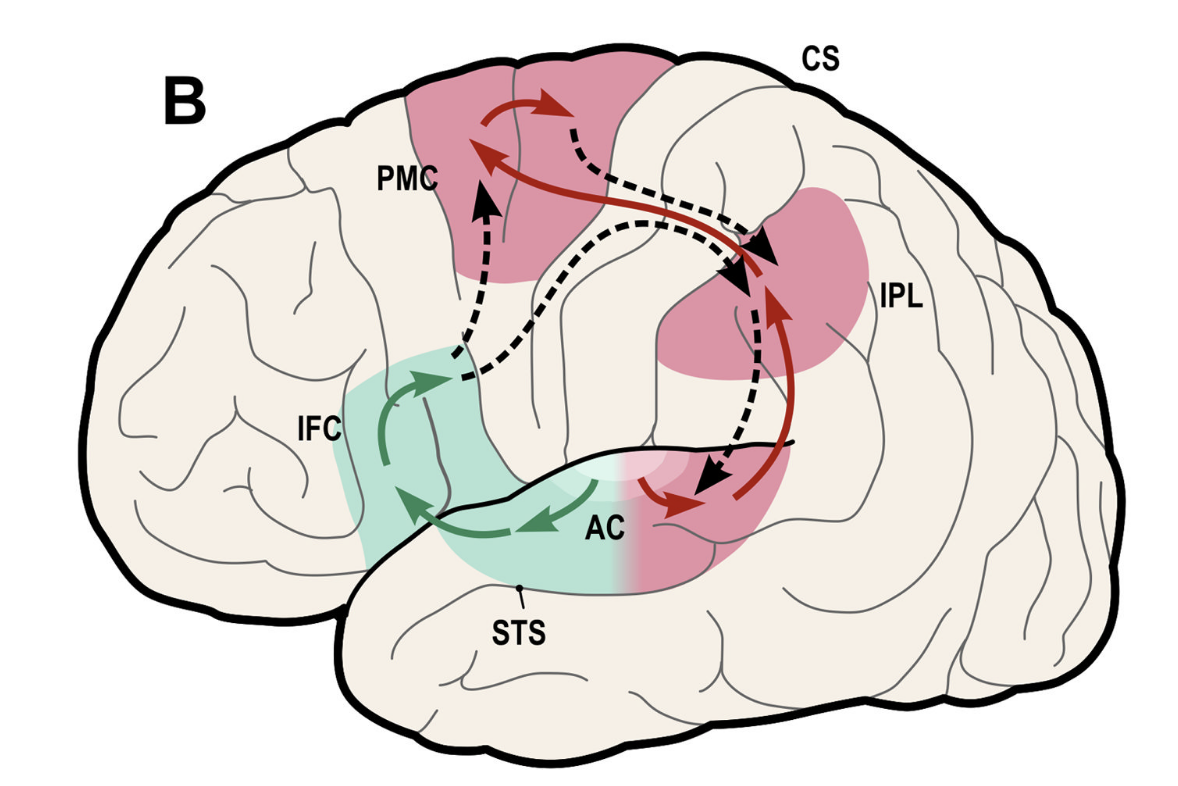
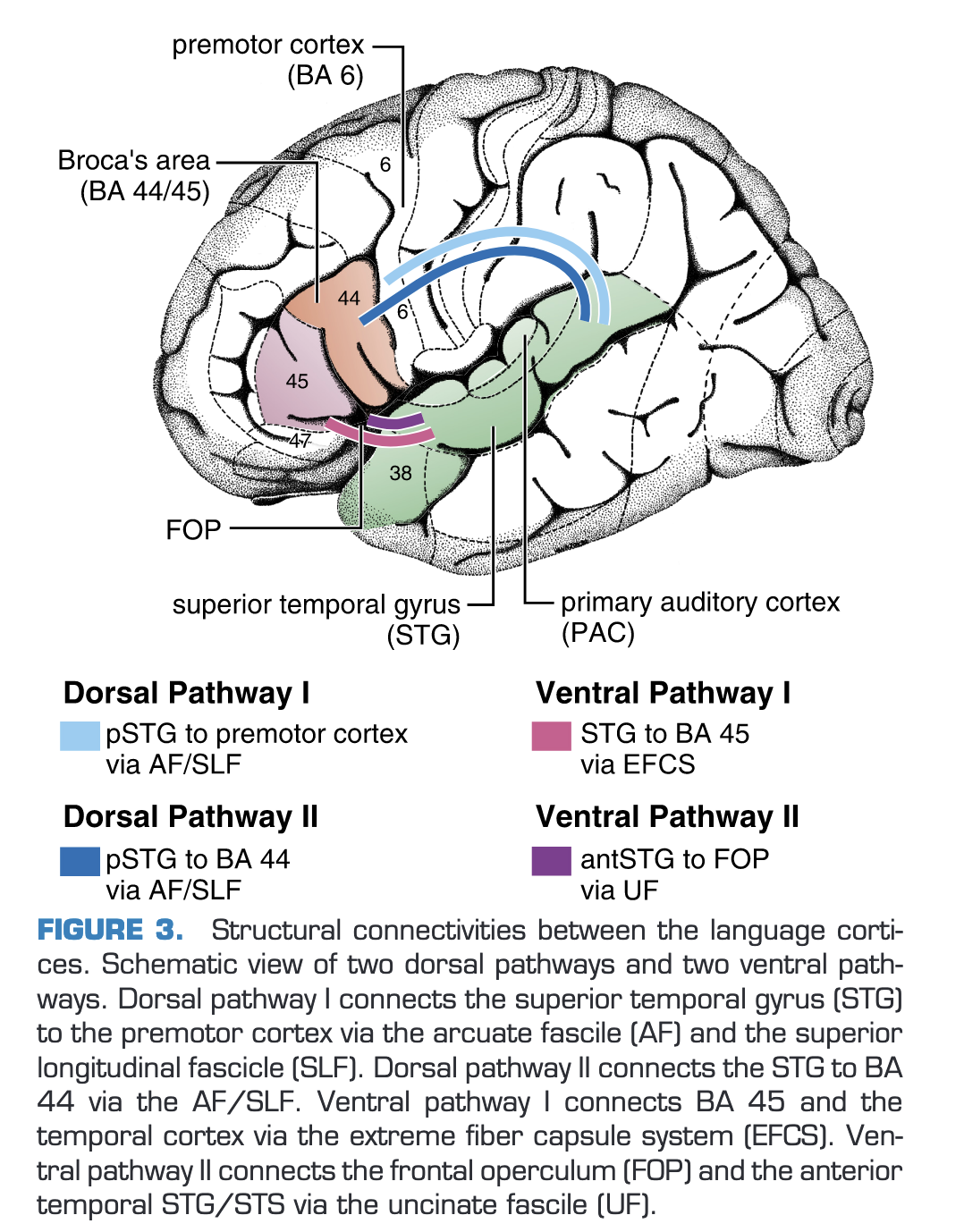
Functional Orientation
Wichtige Orientierungspunkte aus der Literatur:
-
Phonetic vs. spatial sound changes
-
Alpha oscillations as attention-control mechanism
-
Dorsal involvement in affective prosody (Frühholz (2015) - NeuroImage)
-
Semantic vs. spatial processing as alternative classification
(eventuell sinnvoller als rein anatomische Einteilung)
Funktion: Spatial vs Semantic (vs. etwas anderem?)
Vielleicht ist es sinnvoller, zu schauen, was eine Region macht, anstatt nur ihre Location anzuschauen und zu sehen, ob sie zu Dorsal vs Ventral gehört.
Also hier ordnen wir nach Funktion:
Nach Sprache
- A region located posterior, the planum temporale (PT), a region anterolateral to HG called planum polare (PP), and a region at the lateral convexity of the cortex in the STG extending to the superior temporal sulcus (STS). All these regions are involved in the acoustic analysis of speech. (Friederici (2011) - Physiological Reviews)
Region Types Used in This Overview
In general I found much more areas in the Auditory What-Stream (Ventral) than in the Auditory Where-Stream (Dorsal).
This might be due to the evolution of complex semantic understanding and therefore a very elaborate what-stream to the language areas
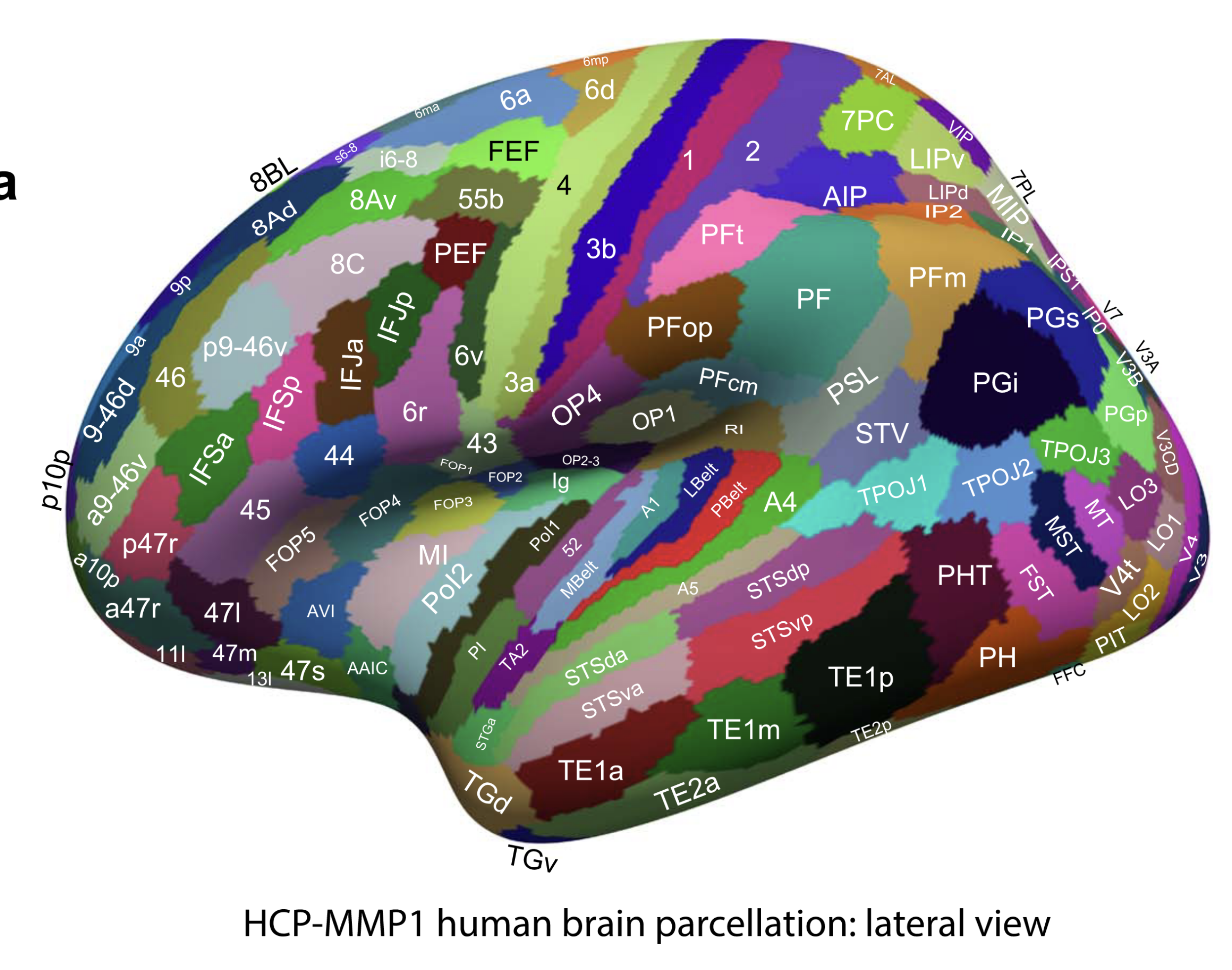
- Glasser Regions
Fine-grained HCP MMP1 parcellation (PGi, A5, STV, TPOJ1, …) - Classical Regions
Traditional anatomical names (IPL, PT, PP, PPo, …) - Networks
DAN, VAN, FPN etc.
Legend
Certainty Indicators:
- ✓ safe (gut belegt)
- ? tentative (noch unklar)