Rauschecker, J. P., & Scott, S. K. (2009). Maps and streams in the auditory cortex: Nonhuman primates illuminate human speech processing. Nature Neuroscience, 12(6), 718–724. https://doi.org/10.1038/nn.2331
- paper gelesen?
- infos rausgeschrieben?
Rauschecker & Scott (2009) - Nature Neuroscience
The inferior parietal lobule (IPL), particularly the angular and supramarginal gyri (Brodmann areas 39 and 40), has also been linked to linguistic functions59, such as the ‘phonological-articulatory loop’60. Functional imaging has confirmed this role, though activity varies with working memory task load61,62. However, the IPL does not seem to be driven by acoustic processing of speech: the angular gyrus (together with extensive prefrontal activation) is recruited when higher-order linguistic factors improve speech comprehension
IPL → PGi
BA39, BA40
monkeys:
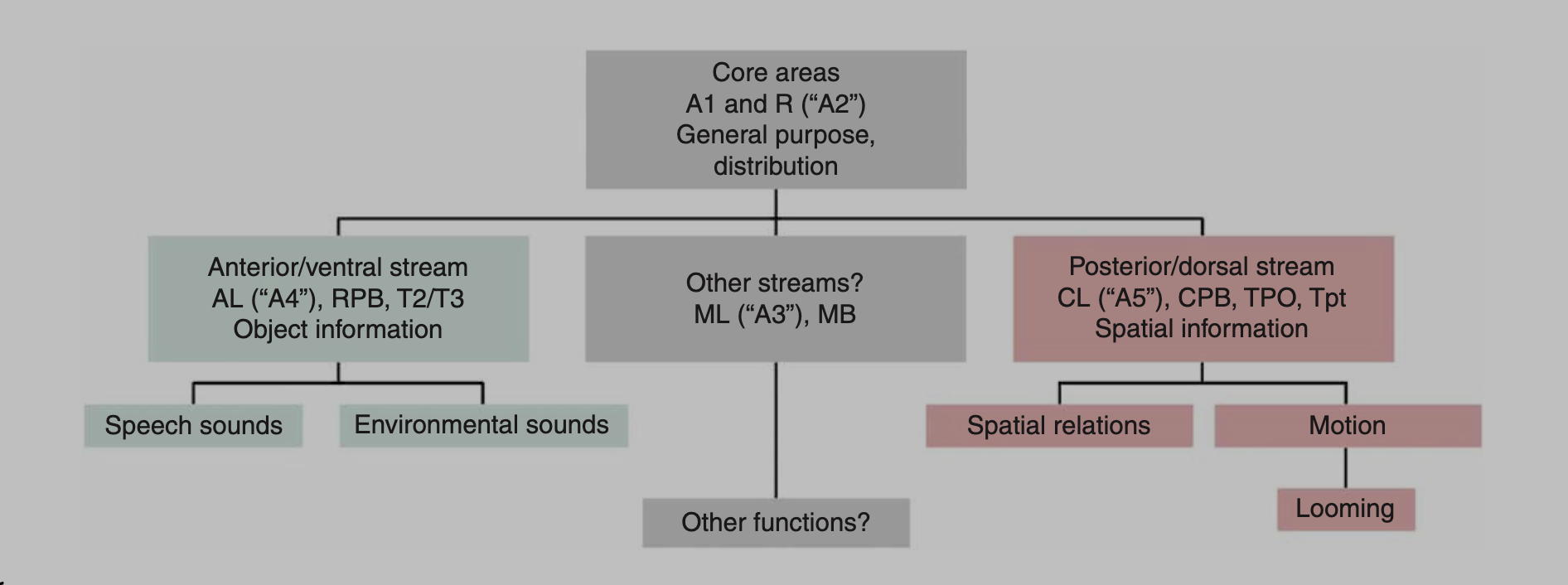
- Anatomical tract tracing studies in monkeys support separate anterior and posterior projection streams in auditory cortex. The longrange connections from the surrounding belt areas project from anterior belt directly to ventrolateral prefrontal cortex (PFC) and from the caudal (posterior) belt to dorsolateral PFC.
- ⇒ heißt, dass die areale nicht zwingend nebeneinander sein müssen
- neurons in the caudo-lateral belt (area CL) are more responsive to spatial location than neurons in core or anterior belt.
ideas:
- Within these speech-specific regions of anterior superior temporal cortex, there may be subregions selective for particular speech-sound classes, such as vowels38,46, raising the possibility that phonetic maps have some anatomical implementation in anterior temporal lobe areas.
- it has been suggested that visual categories are formed in the lateral PFC50, which receives input from higher-order object representations in the anterior temporal lobe10. In audition, using species-specific communication sounds, Romanski et al.51 found clusters of neurons in the macaque ventrolateral PFC encoding similar complex calls, and category-specific cells encoding single semantic categories have also been reported
- The invariance problem in speech perception may be solved in the inferior frontal cortex, or by interactions between inferior frontal and anterior superior temporal cortex.
findings:
- Evidence for a postero-dorsal stream in auditory spatial processing is just as strong, if not stronger, in the human as in nonhuman primates. Stroke studies as well as modern neuroimaging have shown that spatial processing in the temporo-parietal cortex is often right-lateralized in humans, contralateral to language. Generally, spatial neglect is more frequent and severe after damage to the right hemisphere.
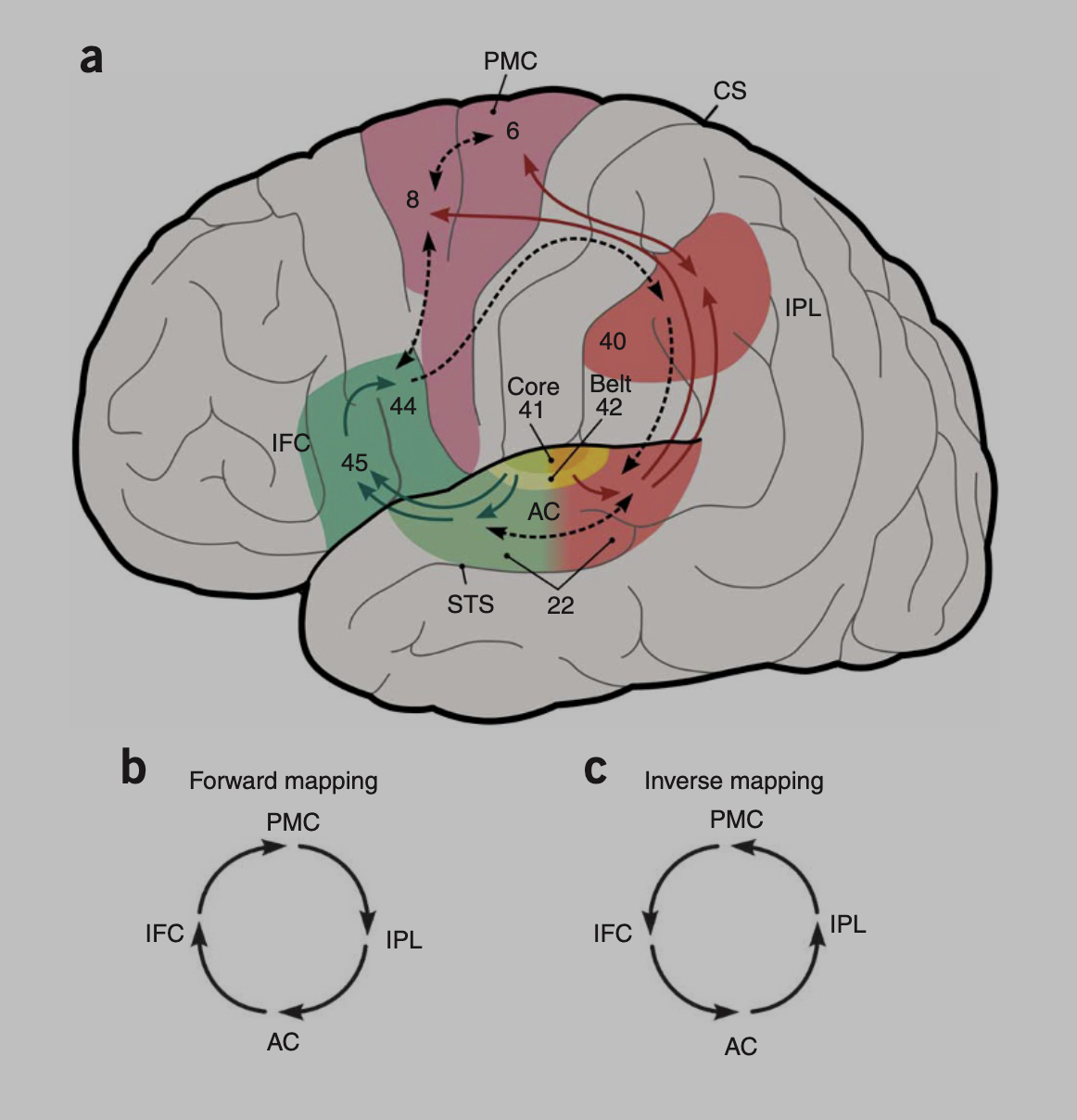
- The inferior parietal lobule (IPL), particularly the angular and supramarginal gyri (Brodmann areas 39 and 40), has also been linked to linguistic functions59, such as the ‘phonological-articulatory loop’60. Functional imaging has confirmed this role, though activity varies with working memory task load61,62. However, the IPL does not seem to be driven by acoustic processing of speech: the angular gyrus (together with extensive prefrontal activation) is recruited when higher-order linguistic factors improve speech comprehension63, rather than by acoustic influences on intelligibility. Thus the parietal cortex is associated with more domain-general, linguistic factors in speech comprehension, rather than acoustic or phonetic processing.
multimodality:
- There is now neurophysiological evidence that auditory caudal belt areas are not solely responsive to auditory input but show multimodal responses64,65: both caudal medial and lateral belt fields receive input from somatosensory and multisensory cortex. Thus any spatial transformations conducted in the postero-dorsal stream may be based on a multisensory reference frame
- Several studies of silent articulation68 and nonspeech auditory stimuli69 find activation in a posterior medial planum temporale region, within the postero-dorsal stream. The medial planum temporale in man70 has been associated with the representation of templates for ‘‘doable’’ articulations and sounds (not limited to speech sounds).
- the postero-medial planum temporale area described in the previous section is an auditory area important in the motor act of articulation
feedforward and feedbackward:
- New work using high-resolution diffusion tensor imaging in humans has revealed that there are direct projections from the pars opercularis of Broca’s area (Brodmann area 44) to the IPL86, in addition to the ones from ventral premotor cortex87. With the known connections between parietal cortex and posterior auditory fields, this could form the basis for feed-forward connections between speech production areas and posterior temporal auditory areas (Fig. 5).
- Later posterior regions participate in the processing of auditory space and motion but seem to integrate input from several other modalities as well.
- The IPL could provide an ideal interface, where feed-forward signals from motor preparatory networks in the inferior frontal cortex and premotor cortex (PMC) can be matched with feedback signals from sensory areas
- The feedback signal coming to the IPL from pST, conversely, could be considered an ‘‘afference copy’’91 with relatively short latencies and high temporal precision92—a sparse but fast primal sketch of ongoing sensory events93 that are compared with the predictive motor signal in the IPL at every instance.
nice to know, additional: - This finding is consistent with results from humans indicating that superior temporal areas are suppressed during speech production81,82 and that the response to one’s own voice is always less than the response to someone else’s.
- Spatial transformations may be one example of fast adaptations used by ‘internal models’ or ‘emulators’, as first developed in motor control theory.
from supplementary material:
- the auditory input to parietal cortex is provided via areas in posterior ST (pST), not directly from primary auditory cortex. This polysynaptic pathway constitutes a processing stream, and pST serves as a transformation stage between core and PPC
- Caudal belt and Tpt’s preferential frontal lobe connections are with the caudal arcuate cortex (area 8a)9-11, which some authors have termed an “auditory spatial zone
- A meta-analysis of altogether 38 human imaging studies provided evidence that the vast majority of auditory spatial studies involved activation of the postero-dorsal pathway (pST, IPL, and SFS), whereas only two activated antero-ventral areas (aST, IFC)
- Imaging studies in humans have demonstrated specific activation in pST with auditory motion24, 25 near the location of visual motion areas MT and MST. Imaging studies that have tested moving auditory stimuli in addition to stationary ones have reported that auditory motion leads to activation in areas of pST and posterior parietal cortex that are adjacent to each other, with motion being the more powerful stimulus14.
see also
Tags: neuroscience science source
Superlink: 050 🧠Neuroscience
Created: 2025-11-12 22:18