Outline 1.0 Introduction
- 1.1. From Wernicke’s to Dual Stream
- 1.1.1 classic visual model (two streams hypothesis)
- 1.1.2 state of the art in the auditory cortex (teaser for the theoretical part)
- 1.1.3 Introduction to dual stream processing
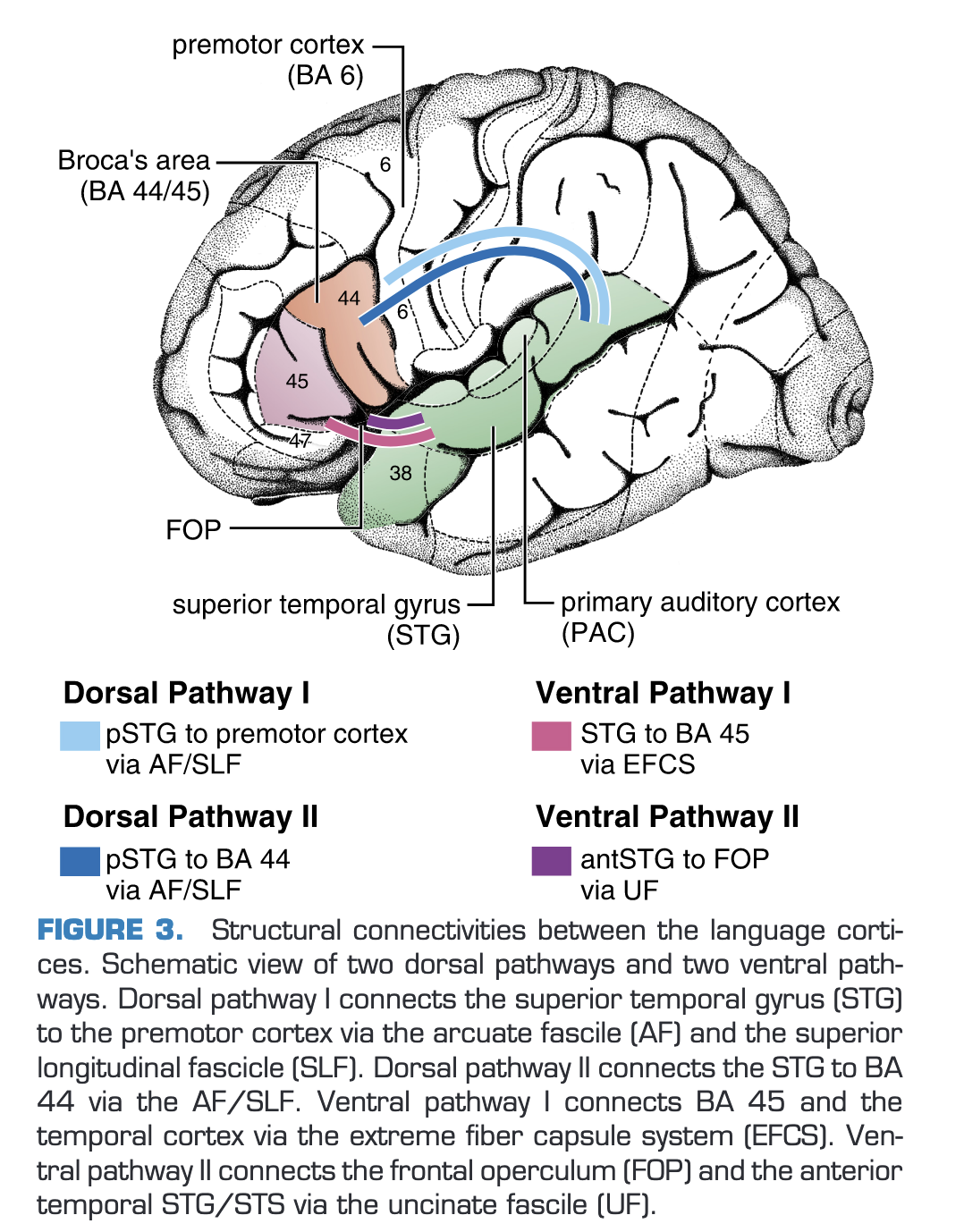
- vielleicht wie Friederici 2011 Figure 3.png
- Einführung in Hickok & Poeppel 2007 - Nature und Rauschecker & Scott (2009) - Nature Neuroscience
- 1.2 The Gap, Top-Down Control of Auditory Streams
- we know that those paths exist, but who controls them?
- Introduction Top-Down Attention
- comaprison to Bedini & Baldauf (2021)
- Ziel: Zeigen, wo die Forschungslücke liegt, gilt diese Aufteilung auch für das Hören?
- 1.3 Hypothesis, A supramodal organization
- prefrontal organization is supramodal
- FEF controls auditory dorsal stream
- IFJ controls auditory ventral stream
1.0 Introduction
1.1. From Wernicke’s to Dual Stream
1.1.1 Two Streams Hypothesis
The brain’s ability of efficiently processing input relies on a sophisticated methods - separating streams that compute different aspects of the inputs. One that computes information about the object itself - shape, colour, type - and the other streams computes motion and spatial information - where is the object in relation to oneself, where is it moving towards?
The discovery of two streams in the brain of the dorsal where and the ventral what stream already occurred in the 1980s, especially for visual inputs. They form a clear pattern starting from the visual cortex and moving anteriorly into the prefrontal cortex. (Quelle?)
The dorsal stream passes through the parietal cortex and terminates in the prefrontal cortex. From there top down attention is directed by the FEF.
The ventral visual stream passes down the temporal lobe passing by FFA and other recognition areas ending in prefrontal cortex. From there top down attention is directed by IFJ (Bedini & Baldauf (2021))For clarity in this paper we will use “where”-stream for the posterodorsal stream and “what” for the anteroventral stream due to some areas that could be location-wise assinged to a different stream than its acutal functional connectivity. Therefore we focus on connectivity, because this is more significant for attention than its pure location.
1.1.2 Dual processing in the auditory cortex
Historically, the neural basis of language comprehension was thought to be localized in a single region: Wernicke’s area predominantly in the left superior temporal gyrus (STG). This classic model dominanted neuroscience for over a century. However, this monolithic was challenged in the 1970s and 1980s by studies revealing that lesions to the left STG did not necessarily lead to deficits in the auditory comprehension, but rather caused deficits in speech production (Hickok & Poeppel 2007 - Nature). These findings lead to a fundamental re-evaluation of auditory cortical organization.
Today a similar structure is widly accepted for auditory inputs as well. What needs to be researched is whether FEF and IFJ function is attention hubs also for the auditory pathways and not only for visual. This is this research looking into.
The auditory system is commonly described as consisting of two major processing streams similar to the visual system with mainly two pathways. The posterodorsal where-stream and the anteriorventral what-stream.
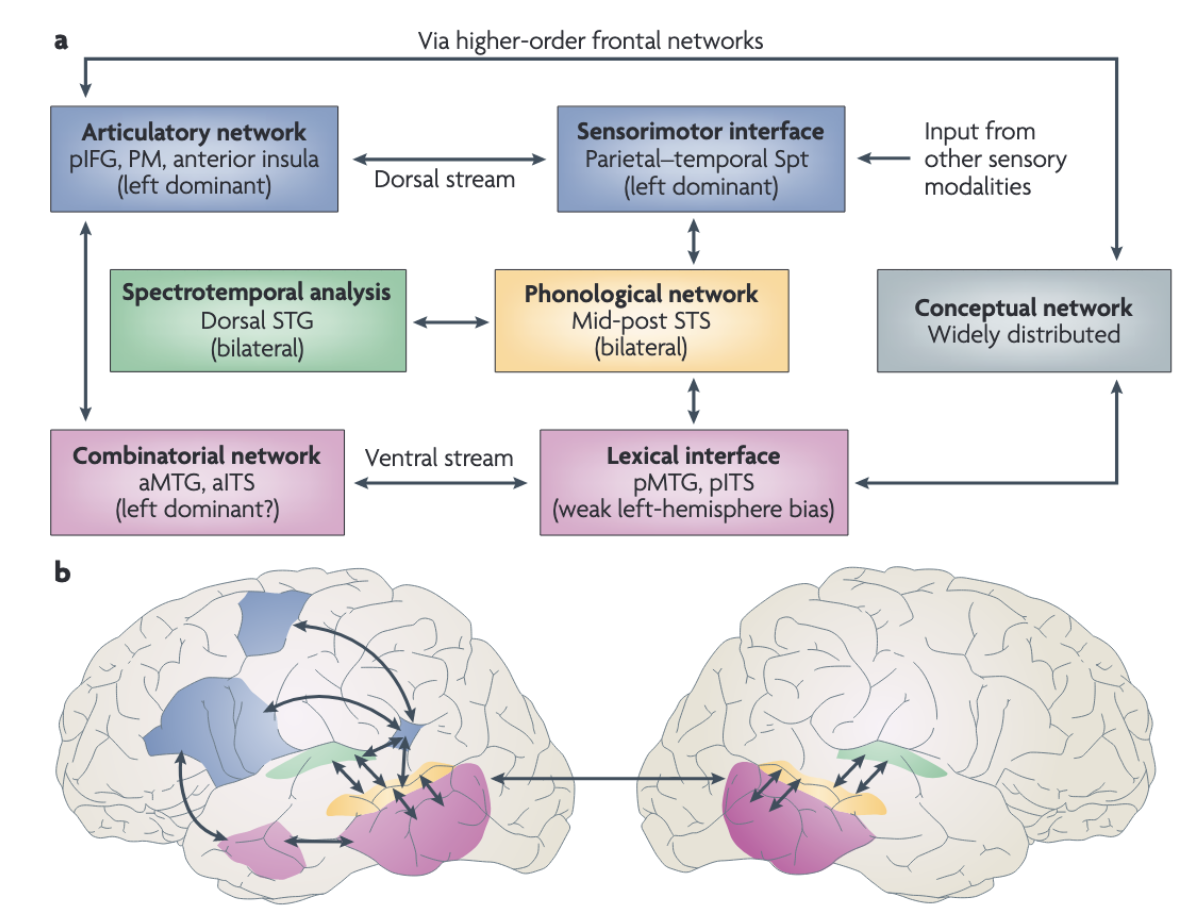
State of the art in the pathway research of auditory cortex are especially developed by Hickok & Poeppel 2007 - Nature and Rolls et al. (2023) - Cerebral Cortex.⇒ soll ich das hier noch weiter ausführen?
also die figure erklären?
wie weit soll ich hier gehen?
Figure 1: Hickock and Poeppel developed a framework explaining the dorsal and ventral auditory streams connecting them to higher-order frontal networks.
Link zum Original
1.2 The Gap, Top-Down Control of Auditory Streams
The division into dorsal and ventral pathways is well-documented(Ahveninen et al. (2006) - PNAS, Hickok & Poeppel 2007 - Nature), but misses how these streams are top-down coordinated. To manage this, the top-down attention is required to filter relevant information and suppress distractors (De Vries & Baldauf (2021) - Journal of Neuroscience). The question remains: Which prefrontal regions act as the conductors for these auditory streams?
In the visual system this question has been answered. Recent neuroimagning research has identified the double-association in the prefrontal cortex, conducted by the FEF and IFJ:
- Frontal Eye Field (FEF): a dorsal region specialized for spatial processing and oculomotor control. It performs a strong top-down influence over the visual where (“dorsal”) stream (Bedini & Baldauf (2021), Bedini (2023) - Brain Structure).
- anterior Inferior Frontal Junction (IFJa): a region located ventrally from the FEF and controls the visual wha “ventral” stream specializing on object-based attention (Bedini & Baldauf (2021))
This is demonstrates a clear “control hub” hierarchy for vision. For the auditory system, the exact top-down “control hubs” are less defined. While Rolls et al. (2023) - Cerebral Cortex and Frühholz (2015) - NeuroImage point out especially IFG and Broca’s areas, such as BA44, 44, BA45, 45, as hubs, this is mainly for the semantic language pathway. There is still a piece missing for the exact controllers, especially for the auditory where-stream. Hickok & Poeppel 2007 - Nature mention a dorsal-motor pathway which might be located in the PT (Hickok & Poeppel 2007 - Nature).
Link zum Original
1.3 Hypothesis, A supramodal organization
We hypothesize that the functional connections of the auditory what and where streams are supramodal within the prefrontal cortex both being coordinated through top-down attention mechanisms from the FEF and IFJ.
In detail:
- The seeds of the Frontal Eye Field (FEF) should preferentially connect to the auditory where-stream
- The seeds of the Inferior Frontal Junction (IFJ) should preferentially connect to the auditory what-stream
Because both FEF and IFJ are known to direct top-down attentional control in the visual domain, we propose that they may play an analogous role for auditory attention as well along the where and what pathways.
In summary we test whether the prefrontal cortex shows the same division of attention direction in the auditory stream as is found in the visual stream.
Link zum Original
see also
3.0 Methods
Type:
Tags:
Status:
Location:
Created: 2025-11-11 17:02