0.1 Outline Bachelorarbeit
- Abstract
Outline 1.0 Introduction
- 1.1. From Wernicke’s to Dual Stream
- 1.1.1 classic visual model (two streams hypothesis)
- 1.1.2 state of the art in the auditory cortex (teaser for the theoretical part)
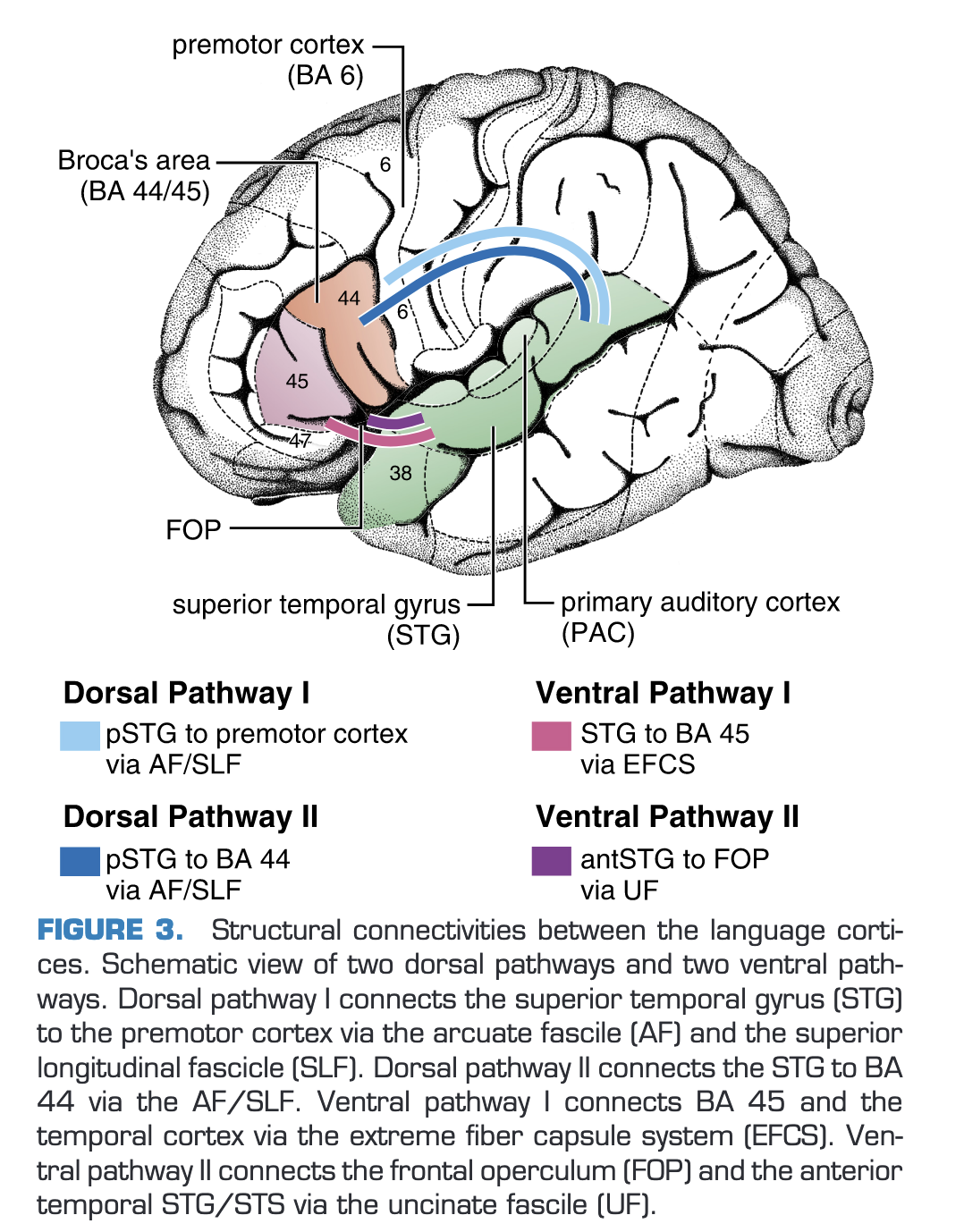
- 1.1.3 Introduction to dual stream processing
- vielleicht wie Friederici 2011 Figure 3.png
- Einführung in Hickok & Poeppel 2007 - Nature und Rauschecker & Scott (2009) - Nature Neuroscience
- 1.2 The Gap, Top-Down Control of Auditory Streams
- we know that those paths exist, but who controls them?
- Introduction Top-Down Attention
- comaprison to Bedini & Baldauf (2021)
- Ziel: Zeigen, wo die Forschungslücke liegt, gilt diese Aufteilung auch für das Hören?
- 1.3 Hypothesis, A supramodal organization
- prefrontal organization is supramodal
- FEF controls auditory dorsal stream
- IFJ controls auditory ventral stream
- 1.1. From Wernicke’s to Dual Stream
Outline 2.0 Theoretical Background
Link zum Original
- 2.1 The Auditory What (“Ventral”) Stream
- Definition
- Funktion
- lateralization differences
- Anatomie
- Rolls Group 1
- 2.2 The Auditory Where (“Dorsal”) Stream
- 2.2.1 Debate
- Rauschecker vs Hickock&Poeppel (where vs how)
- beide modelle erklären
- 2.2.2 Anatomical Definition & Evidence
- Glasser area A4, A5, Parietal Cortex
- Rolls Group 3
- 2.2.3 Synthesis
- Defining the where-stream as spatial/motion stream (maybe motor?)
- 2.3 Top Down Control
- FEF
- IFJ
- abgrenzen von IFJp, 44/45/47l
- Supramodal Hypothesis
- 2.4 Anatomical and Classification Challenges
- A4 & A5
- TPOJ1
- STSdp
- PSL
- STV
- 2.5 Table of Regions of Interest (ROIs)
- where-stream ROIs
- what-stream ROIs
Outline 3.0 Methods
Link zum Original
- 3.1 Data Acquisition & Preprocessing
- Human connectome project
- participants
- scanning parameters (fMRI, 7T?)
- Preprocessing (FDR, Denoising?)
- 3.2 Cortical Parcellation with The HCP-MMP1 Atlas
- 3.2.1 Why Glasser?
- Myelin + fMRI über Cytoarchitecture
- Atlas definition
- wie funktioniert der Atlas?
- 3.3 Selection of Regions of Interest (ROIs)
- 3.3.1 Seed definition
- FEF
- IFJa
- 3.3.2 Target Definition
- what targets (liste)
- where targets (liste)
- 3.4 Statistical Analysis
- 3.4.1 functional connectivity
- 3.4.2 Partial/full Correlation
- 3.4.3 Correction (FDR) Erklärung
- 3.5 Brain Behaviour Correlation
- wie machen wir Predicitie Modelling (WM/Language_Story)
Outline 4.0 Results
Link zum Original
- 4.1 Global Connectivity Patterns
- validation of seed regions (FEF, IFJa)
- 4.2 Testing the “Where” Stream (FEF Connectivity)
- Motion Areas reinnhemen MT/MST
- 4.3 Testing the “What” Stream (IFJa Connectivity)
- Strong connection to semantic system
- vergleichen mit IFJp
- vergleichen mit 44/45/47l
- 4.4 Resolving Ambiguities
- whether A5 aligns more with IFJ or FEF
- PSL alignment
- STV alignment
Outline 5.0 Discussion
Link zum Original
- 5.1 confirmation of the supramodal oganization
- summarization of FEF/IFJ connectivity as in Bedini & Baldauf (2021)
- the brain uses “general purpose” attention hubs in the prefrontal cortex
- 5.1.1 Top-Down control architecture
- FEF connection to auditory motion
- FEF connection to speech motor
- maybe subclusturs within FEF and IFJ?
- 5.2 Re-evaluating the auditory where stream
- 5.2.1 The spatial Link
- FEF connection to A4, MT, MST
- mit Rauschecker & Scott (2009) - Nature Neuroscience diskutieren, zeigt dass es räumlich ist
- 5.2.2 The motor link
- FEF controls motor actions
- connections to BA44?
- diskutiere Hickok & Poeppel (2004) - Cognition
- 5.3 Re-evaluating the auditory what stream
- IFJ semantics
- discussing Rolls et al. (2023) - Cerebral Cortex and the groups mentioned
- IFJ vs 44, 45, 47l
- vielleicht bezogen auf Bedini & Baldauf (2021) als ein multiple demand system
- 5.4 anatomical Ambiguities
- A5
- PSL
- STSdp
- 5.5 Predictive Modelling
- aus Glasser et al. (2016) - Nature SUPPL die offline Tasks LANGUAGE-STORY anschauen und scores vergleichen
- auf De Vries & Baldauf (2021) - Journal of Neuroscience eingehen
- 5.6 Hemispheric Lateralization
- Left hemisphere
- bestätigung von Hickok & Poeppel 2007 - Nature
- right hemisphere
- bestätigung von Frühholz (2015) - NeuroImage und Griffiths et al. (1998)
- 5.7 Limitations and Future directions
- resting state fMRI ist indirekt
- glasser atlas ist top, aber manche areale könnte man weiter unterteilen wie A4, A5
- Effective Connectivity nutzen, um die richtung Top-down zu beweisen
- MEG nutzen, um die Frequenzen zu sehen De Vries et al. (2021) - Journal of Neuroscience
| Kapitel | Seiten (ca.) | Wörter (ca.) | Ziel & Fokus |
|---|---|---|---|
| 1. Introduction | 2.5 | 800 | Der Pitch. Warum wir das machen. Kurz & knackig. |
| 2. Theory | 8 | 2.500 | Das Fundament. Ventral vs. Dorsal-Debatte. Glasser. |
| 3. Methods | 4 | 1.200 | Das Handwerk. Präzise, technisch, reproduzierbar. |
| 4. Results | 5 (davon viel Grafik) | 1.500 | Die Fakten. Nüchtern beschreiben, nicht interpretieren. |
| 5. Discussion | 9 | 3.000 | Das Hirn. Deine Synthese, Supramodalität, Action-in-Space. |
| 6. Conclusion | 1.5 | 500 | Das Fazit. Take-home message. |
| Total | ~30 | ~9.500 |
see also
Type:
Tags:
Status:
Location:
Created: 2026-02-09 12:21