Outline & To-Do
- Historical part
1.1. From Wernicke’s to Dual Stream
1.1.1 Two Streams Hypothesis
The brain’s ability of efficiently processing input relies on a sophisticated methods - separating streams that compute different aspects of the inputs. One that computes information about the object itself - shape, colour, type - and the other streams computes motion and spatial information - where is the object in relation to oneself, where is it moving towards?
The discovery of two streams in the brain of the dorsal where and the ventral what stream already occurred in the 1980s, especially for visual inputs. They form a clear pattern starting from the visual cortex and moving anteriorly into the prefrontal cortex. (Quelle?)
The dorsal stream passes through the parietal cortex and terminates in the prefrontal cortex. From there top down attention is directed by the FEF.
The ventral visual stream passes down the temporal lobe passing by FFA and other recognition areas ending in prefrontal cortex. From there top down attention is directed by IFJ (Bedini & Baldauf (2021))
For clarity in this paper we will use “where”-stream for the posterodorsal stream and “what” for the anteroventral stream due to some areas that could be location-wise assinged to a different stream than its acutal functional connectivity. Therefore we focus on connectivity, because this is more significant for attention than its pure location.
1.1.2 Dual processing in the auditory cortex
Historically, the neural basis of language comprehension was thought to be localized in a single region: Wernicke’s area predominantly in the left superior temporal gyrus (STG). This classic model dominanted neuroscience for over a century. However, this monolithic was challenged in the 1970s and 1980s by studies revealing that lesions to the left STG did not necessarily lead to deficits in the auditory comprehension, but rather caused deficits in speech production (Hickok & Poeppel 2007 - Nature). These findings lead to a fundamental re-evaluation of auditory cortical organization.
Today a similar structure is widly accepted for auditory inputs as well. What needs to be researched is whether FEF and IFJ function is attention hubs also for the auditory pathways and not only for visual. This is this research looking into.
The auditory system is commonly described as consisting of two major processing streams similar to the visual system with mainly two pathways. The posterodorsal where-stream and the anteriorventral what-stream.
State of the art in the pathway research of auditory cortex are especially developed by Hickok & Poeppel 2007 - Nature and Rolls et al. (2023) - Cerebral Cortex.
⇒ soll ich das hier noch weiter ausführen?
also die figure erklären?
wie weit soll ich hier gehen?
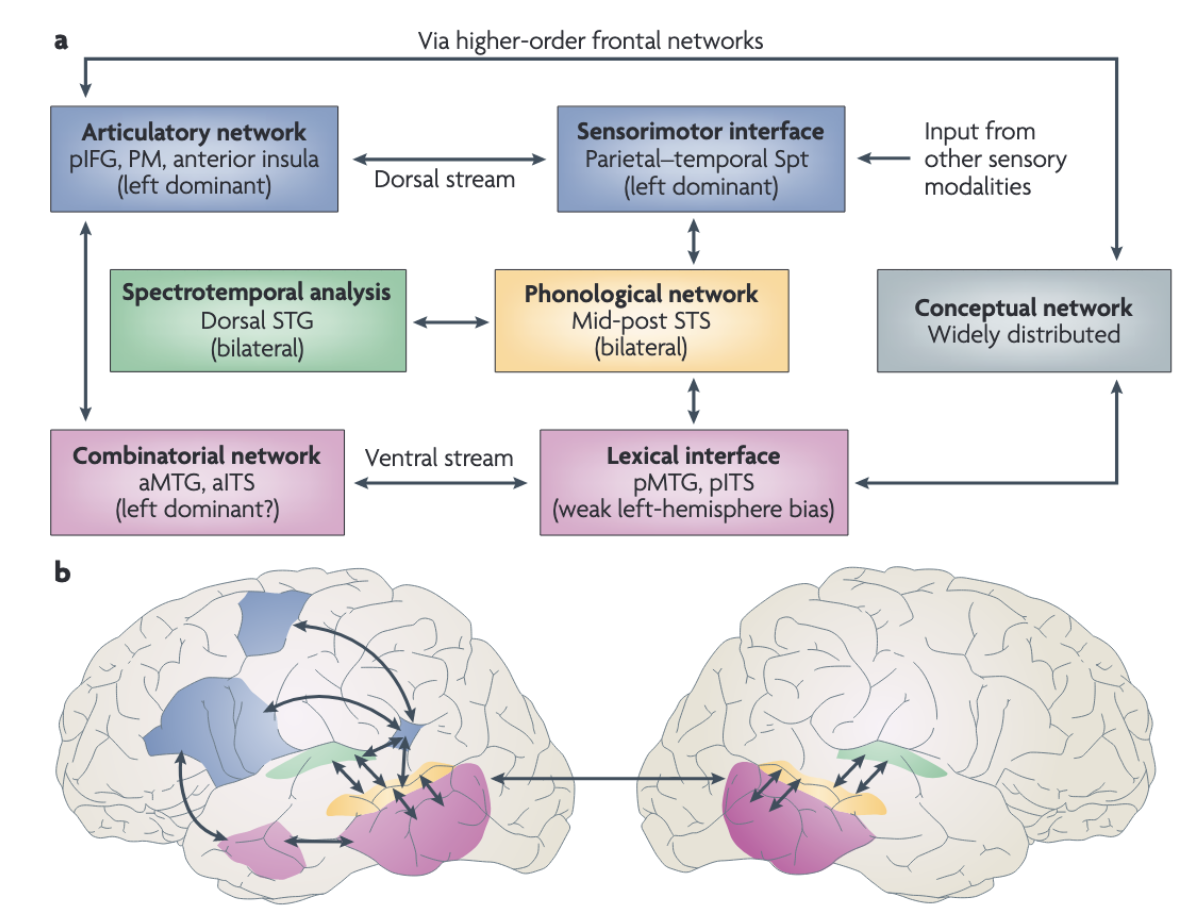
Figure 1: Hickock and Poeppel developed a framework explaining the dorsal and ventral auditory streams connecting them to higher-order frontal networks.
Notes & Scrapbook
Hier Dinge abladen, die noch keinen Platz im Text haben, damit der Schreibfluss nicht stoppt.